research
To learn more about our ongoing research projects, please check out our recent publications.
End to End Algorithmic Development
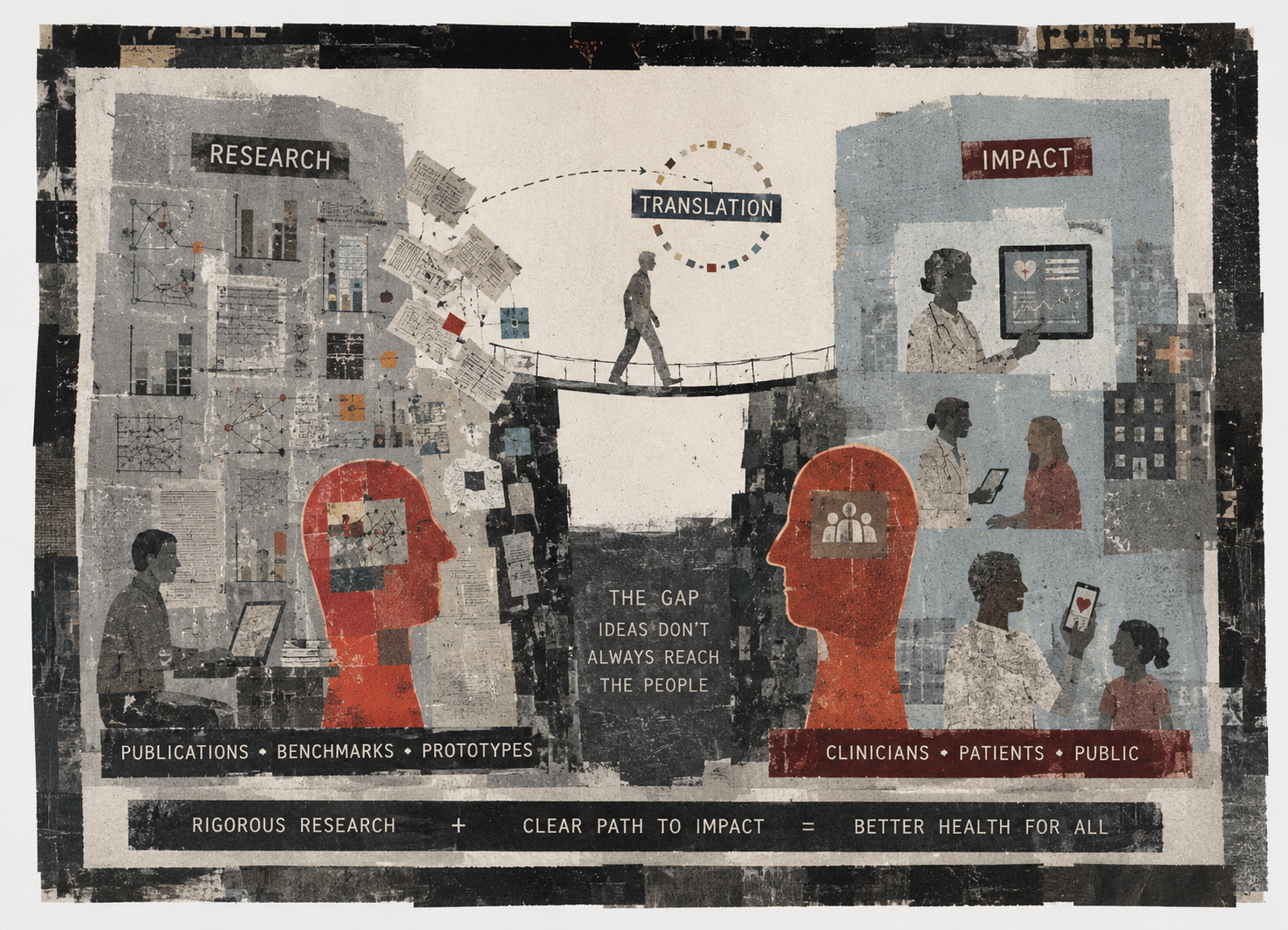
Despite the rapid pace of progress in artificial intelligence for healthcare, much of the research developed in academia never reaches the people it is ultimately intended to benefit. Many promising methods remain confined to publications, benchmarks, or prototype systems without being translated into tools that meaningfully improve patient care or everyday health. Having had the opportunity to work at frontier industry research labs, I have been fortunate to experience a different perspective—one in which research is carried through to deployment as products and features used to support health and wellness at scale. This experience has shaped my research philosophy: to pursue ideas that are not only scientifically rigorous, but also designed with a clear path toward real-world impact for clinicians, patients, and the broader public.
Foundation Models
Another research focus is the development of foundation models for longitudinal health data, with an emphasis on wearable sensor time series and electronic health records (EHRs). By leveraging self-supervised learning and large-scale pretraining, this research aims to learn general-purpose representations that can be adapted to a broad range of downstream tasks, including disease prediction, risk stratification, personalized health monitoring, and clinical decision support. Such representations are particularly valuable in healthcare, where labeled data are often scarce, expensive to curate, and subject to privacy constraints, enabling robust performance even in low-label regimes.
World Models
Another research direction is the development of world models for health that learn latent representations of health status and human physiology over time. By modeling the dynamics of longitudinal health trajectories, these models can simulate plausible future outcomes under different interventions, such as exercise, sleep, and medications, enabling in silico counterfactual reasoning before decisions are made in the real world. This line of research seeks to establish a principled framework for forecasting future health states and evaluating intervention strategies through learned models of patient trajectories, with the long-term goal of advancing personalized and preventive health and wellness.